
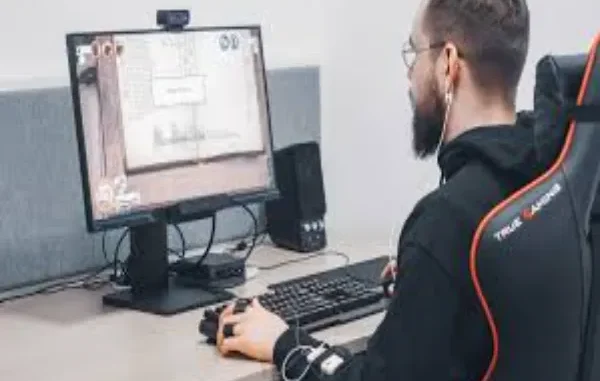
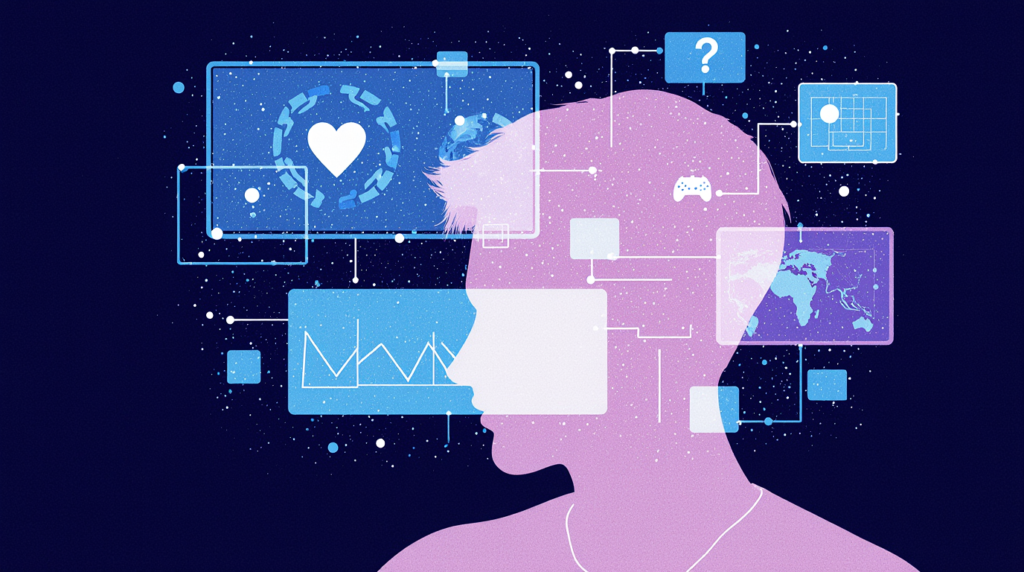
The controller isn’t the only thing reading your input anymore. In 2025, games have learned to feel you back. Heart rate monitors, eye-tracking sensors, and even facial recognition software now allow games to respond dynamically to your emotions. The result is a new kind of intimacy between human and machine – one where your heartbeat, fear, and focus become part of the gameplay.
For decades, developers dreamed of worlds that adapt to player behavior. Today, thanks to biometrics and emotional AI, that dream is not just possible – it’s becoming standard. What was once science fiction is now an industry trend shaping design, ethics, and even mental health.
The Body as Controller
Modern games can now sense physical and emotional changes in real time. Wearable tech like the Apple Vision Pro, Neuralink prototypes, and Razer’s Anzu Bio headsets track subtle signals – heart rate, pupil dilation, muscle tension, and breathing rhythm – all without interrupting play.
These signals feed directly into the game’s adaptive algorithms. In horror titles, if your heart rate spikes, enemies grow bolder. In driving simulators, stress might increase steering sensitivity. And in story-based experiences, your facial expressions can alter dialogue outcomes, making each player’s narrative uniquely personal.
This shift is already visible across competitive and casual genres. Real-time stress response systems, tested in esports training, have improved reaction efficiency by 9–15% according to MIT Human Interface Lab (2024). Games are learning not only how we play but how we feel while playing.
Emotional Design and Adaptive Gameplay
The true frontier isn’t just data collection – it’s emotional design. Game developers now craft dynamic experiences that interpret biometric cues as part of storytelling. Imagine a stealth game that becomes harder when you panic, or an RPG that rewards calmness under pressure.
Fast-reaction titles such as Melbet BD Crash already echo this philosophy in simplified form. The gameplay, based on timing and self-control, reflects the psychological tension of risk and reward. Every rising multiplier tests your nerve: when to hold on, when to let go. While not fully biometric, it mimics the essence of emotional feedback loops that drive modern gaming – the symbiosis between physiological reaction and strategic decision-making.
The next step, experts predict, is bio-adaptive AI – systems that use emotional patterns to shape content in real time. According to TechTarget 2025, at least one-third of AAA titles in development integrate some form of biometric or emotional analytics in their design pipeline.
Ethics and Empathy
But the rise of emotional computing brings serious ethical questions. Who owns your biometric data? How is it stored, interpreted, or monetized? A game that knows your fears or stress levels has access to deeply personal information – and that raises the stakes for data privacy and consent.
Organizations like the Entertainment Software Rating Board (ESRB) and EU Digital Ethics Council are drafting frameworks to ensure emotional analytics are used responsibly. Developers are required to anonymize sensor data and offer opt-out systems. Yet, regulation lags behind innovation, and the emotional economy of gaming continues to expand faster than oversight can follow.
At its best, this technology promises empathy. Games can become more inclusive for neurodiverse players or those with anxiety, adjusting intensity or pacing based on biometric feedback. At its worst, it risks turning human emotion into another monetized metric.
The Science of Feeling
To understand the impact of emotional gaming, psychologists at Stanford’s Virtual Human Interaction Lab (2024) conducted experiments where participants played adaptive titles that responded to heart rate and pupil changes. Players reported higher immersion and emotional connection, but also faster fatigue. The findings suggest that emotional gaming amplifies engagement but also magnifies vulnerability.
Games that “feel back” create a mirror effect: they reflect our internal states in real time. If you’re frustrated, the game might ease its difficulty. If you’re calm, it may push harder. This creates what researchers call “empathic design” – software that respects the player’s rhythm instead of forcing uniform experience.
A New Kind of Intelligence
The fusion of biometric sensing and emotional AI is turning games into hybrid art forms – half machine, half psychologist. Developers no longer build static challenges but relationships. The game studies your behavior, learns your habits, and adapts to become your mirror, your rival, or your ally.
This approach also influences how players perceive fairness and agency. When the system knows you better than you know yourself, it can either empower or manipulate you. The difference lies in intent – in whether developers use emotion to enhance experience or exploit it.
Responsible platforms such as MelBet register demonstrate how technology and trust can coexist. With encrypted systems, transparent registration policies, and clear consent protocols, MelBet integrates emotion-driven engagement within ethical limits. As gaming grows more personal, such responsibility becomes not an option but a standard.
The Future: Games That Understand You
In the near future, you may not choose difficulty levels – the game will read your mind and adjust automatically. Your smartwatch, your headset, even your chair will be sensors. Games will know when you’re relaxed, tired, or distracted, and shift accordingly.
Biometric personalization could also revolutionize therapeutic gaming. Adaptive relaxation apps are already being used for PTSD recovery and anxiety management, where the game measures your heartbeat to guide breathing patterns and focus.
But the emotional connection cuts both ways. As games learn to feel us, they teach us to feel more deeply through them. They can awaken empathy, self-awareness, and emotional literacy – not just skill.
Final Thought
When the game feels the player, control becomes collaboration. It’s not just about pressing buttons anymore; it’s about connection. Your pulse becomes code, your emotion becomes narrative.
The future of gaming isn’t about higher resolution – it’s about higher resonance. And the more we understand how technology reads our hearts, the better we can decide what kind of stories we want it to tell.