
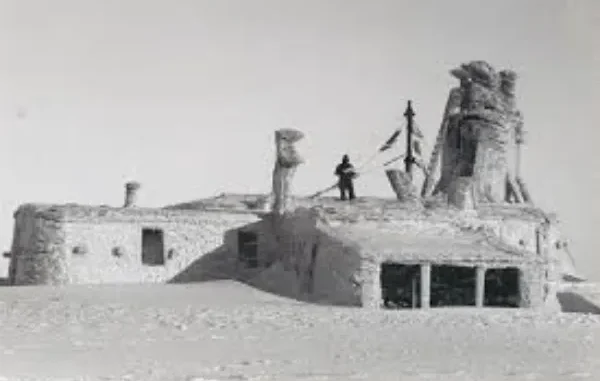
Imagine a place where winter doesn’t just arrive; it explodes. A place where the wind screams loud enough to shatter sanity, and your front door can become sealed behind a wall of ice for weeks on end. Now, imagine choosing to live there for a year. This wasn’t a punishment or a feat of reckless endurance. It was science.
High on the windswept, cloud-shrouded plateau of Ben Nevis, Britain’s tallest mountain, a small group of Victorian gentlemen did exactly that. They climbed into the sky to live in a lost observatory. Their story is one of breathtaking bravery, bone-chilling hardship, and a thirst for knowledge so powerful it could warm you in a blizzard. It’s a level of dedication you can learn from when playing on your favourite online mobile casino app!
A Grand Idea Born in the Clouds
We start not on the mountain-top, but in the head of a Victorian gentleman called Clement Lindley Wragge. He was a wild-eyed meteorologist who was fascinated with the weather. Later in the 1870s, he devised a scheme which was both daring and plain. He thought of a permanent weather station on the summit of Ben Nevis. Weather forecasting back then was still a primitive art. It was observed at low altitudes, providing the scientists with an incomplete view of the great systems of the atmosphere rolling across the Atlantic. To really know what was going on, Wragge maintained, you had to go to where it was made. Into the clouds themselves.
The idea caught fire. The Scottish Meteorological Society, along with the masses and even the royal family, came to the rescue of the project. But first, they needed a path. It was necessary to cut a pony trail into the side of the mountain before even the first stone of the observatory could be laid. It was a Herculean task of physical labor where men and horses moved loads of equipment up a near-vertical surface.
They constructed the sturdy, stone-walled observatory at no higher a point than a plateau just beneath it, with a less ferocious perch. By 1883, the building was complete. It was two stories high and was designed to endure whatever the worst nature has to offer. And here, the first body of observers were to enter and open their glorious tenure.
Life at the Top of the World
The observatory was a tiny island in a sea of rock and cloud. The team, usually four or five men, lived in a state of enforced intimacy, their world shrinking to the dimensions of their sturdy stone walls when the weather closed in. And close in it did, with alarming frequency.
The Daily Grind of Scientific Devotion Their days were governed by a rigid, unbreakable schedule. Every hour, on the hour, day and night, 365 days a year, one of the observers had to venture outside to read the instruments. This was the core of their mission. They measured temperature, air pressure, wind speed, and rainfall. They noted the type and movement of clouds. They recorded every nuance of the mountain’s savage climate.
In a howling gale, with horizontal snow cutting like shards of glass, a man had to step out into the abyss. They tied ropes to themselves and to iron stanchions sunk into the rock, creating lifelines to prevent them from being blown clear off the mountain. Imagine untying yourself to read a thermometer, your fingers instantly numb, your mind screaming at you to go back inside, while the wind tries to pluck you from the ridge. This was their hourly reality.
The Unseen Enemy: Isolation and Cold But the physical danger was only half the battle. The isolation was profound. In winter, the sun barely skimmed the horizon, leaving them in a perpetual twilight for weeks. The observatory could be buried under snow for months at a time, cut off entirely from the world below.
Provisions, carried up by hardy mail contractors who often had to crawl on their hands and knees across the final snowfields, were a lifeline. Letters from home were devoured, read and re-read until they fell apart. Their primary entertainment was each other. They played chess and kept remarkably detailed journals. They were, in essence, the first reality TV stars, except their drama was real, their confinement absolute, and their mission was to capture data, not fame.
Glimpses of Sublime Beauty
Not all that was misery and frozen fingers. Now and then, there were transcendent beauties which made it all worth it. As the clouds would part ways occasionally, people were presented with a sight that very few human beings had ever witnessed. They were above the weather, gazing down a sea of whitish cloud upon the horizon, the spikes of other mountains like islands in a phosphoric sea. On rare crystal-clear days, they might see the hills of Ireland and the contours of the Outer Hebrides.