
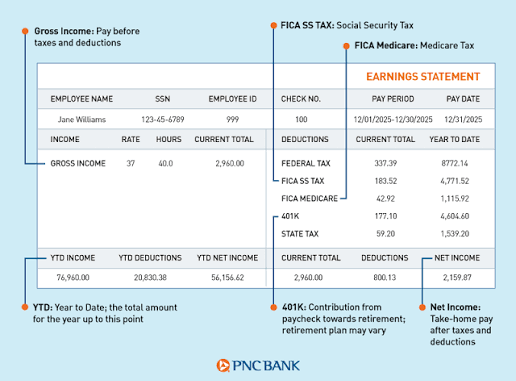
Politics rarely feels personal until it shows up in your bank account. Yet almost every wage earner carries a small, running record of policy decisions in their pocket: the pay stub. The figures printed on it (gross pay, withholdings, deductions, net pay) are the direct result of laws written and rewritten in legislatures and agencies. For a readership that follows campaigns, budget fights, and labor debates, the pay stub is one of the clearest places to see abstract policy turn into real money.
Why the Pay Stub Is a Political Document
Every line on a pay stub traces back to a rule someone voted on. Federal income tax withholding follows brackets and tables that Congress and the Treasury adjust. Social Security and Medicare contributions come from rates set in statute. State income tax, where it exists, reflects choices made by state lawmakers, which is why a worker in one state keeps a different share of the same salary than a worker in another.
When candidates argue about tax cuts, child tax credits, or payroll tax holidays, they are arguing about these exact lines. A change to a standard deduction or a withholding table does not stay in a policy memo. It moves the net pay number that lands in your account every two weeks. Reading a pay stub closely is, in a quiet way, a form of civic literacy.
Withholdings: Where the Debate Gets Concrete
The withholding section is where most political fights become visible. Income tax withholding depends on how you complete your W-4 and on the tables the IRS publishes. Those tables shift when tax law changes, so a reform passed in one session can alter take-home pay months later without any action on your part.
Payroll taxes for Social Security and Medicare are split between employer and employee, a structure that policymakers revisit whenever the long-term funding of those programs is on the table. The IRS explains the basics of these obligations in its overview of understanding employment taxes, which is a useful reference for anyone trying to match the deductions on their stub to the rules behind them.
Benefit deductions belong in this conversation too. Health insurance premiums, retirement contributions, and similar items often come out before taxes, and the tax treatment of those contributions is itself a policy choice. When lawmakers debate the deductibility of retirement savings or the rules around health plans, they are shaping how much of your paycheck is taxed and how much is sheltered.
Proof of Income in a Shifting Gig Economy
Policy debates over how workers are classified have made proof of income a live issue, especially for freelancers and gig workers. A salaried employee receives a stub automatically, but independent contractors usually do not. As more of the workforce moves to contract and platform work, the question of how these workers document earnings for a lease, a loan, or a mortgage becomes a practical and a political one.
This is where reliable income documentation matters. Tools such as PayStubCreator let self-employed earners generate clean, accurate records of what they make, which can stand in for the stub a traditional employer would provide. Services like PayStubs.net serve a similar purpose, giving freelancers and small business owners a straightforward way to produce consistent earnings records when a landlord or lender asks for them.
The policy backdrop here is real. Worker classification rules decide who counts as an employee and who counts as a contractor, and that line determines who gets a stub by default and who has to assemble their own paper trail. As that debate continues, the ability to document income cleanly becomes less of a convenience and more of a necessity.
Reading the News and Reading Your Paycheck
Politics is often described as a contest of strategy and risk, a framing that politicser.com has explored in pieces like Politics as a Game of Poker. The same instinct that makes someone follow the bluffs and bets of a campaign can be turned toward the paycheck, where the stakes are personal and the outcomes are measured in dollars kept or lost.
The next time a tax proposal or a labor bill makes headlines, it is worth pulling out a recent pay stub and looking for the line it would touch. You may find that the policy story playing out in the news has a smaller, quieter version printed on a slip of paper you already own. Following both, the public debate and the private numbers, is one of the more useful habits a citizen and a worker can keep.