
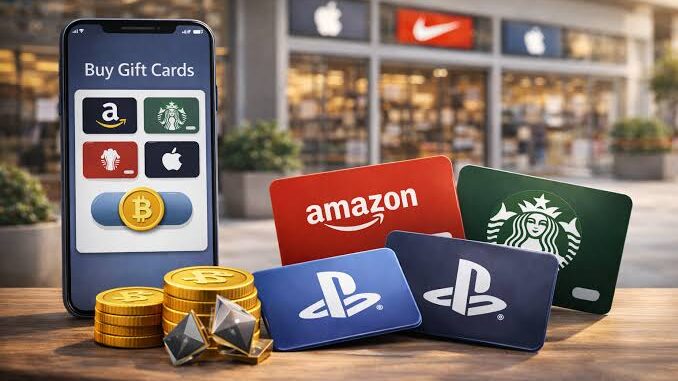
Cryptocurrency has become easier to buy, hold and transfer, but spending it in everyday life can still feel unnecessarily complicated. Most shops do not accept Bitcoin, Ethereum or stablecoins directly, and converting digital assets into traditional currency may involve exchanges, withdrawal procedures and additional waiting time.
Digital gift cards offer a practical bridge between these two financial worlds. Instead of waiting for every retailer to adopt blockchain payments, crypto holders can purchase prepaid codes for products and services they already use. This makes cryptocurrency useful beyond trading, investing or transferring money between wallets.
Turning Digital Assets Into Practical Value
The original appeal of cryptocurrency included the ability to transfer value without relying entirely on traditional banking infrastructure. However, transferring an asset is not the same as being able to spend it conveniently.
Someone may hold Bitcoin or USDC but still need traditional payment methods when buying games, paying for a streaming subscription or shopping online. A digital gift card solves this problem by converting a chosen amount into credit accepted by a specific brand.
Platforms such as ACEB.com allow customers to buy gift cards with crypto without requiring the retailer itself to accept cryptocurrency. The customer pays using a supported digital asset and receives a code that can be redeemed according to the selected brand’s conditions.
The process does not turn every retailer into a crypto merchant. Instead, it creates an accessible connection between blockchain-based payments and existing retail systems.
Why Gift Cards Work Well With Cryptocurrency
Digital gift cards and cryptocurrency share several characteristics that make them a natural combination.
Both can be purchased and delivered online. There is no need to ship a physical card, and the recipient can usually access the code by email after the payment has been confirmed. This is particularly useful for last-minute gifts, remote purchases and customers who prefer digital products.
Gift cards also give a crypto payment a clear purpose. Rather than converting a large amount through an exchange, a customer can use a defined portion of a digital balance for a particular purchase or service.
Common uses include:
- buying games or adding credit to a gaming account;
- paying for entertainment and streaming services;
- shopping for electronics, clothing or household products;
- ordering food or using delivery services;
- booking travel-related products;
- sending a digital gift to someone in another location.
Availability varies by country and brand, but the underlying model is straightforward: cryptocurrency is used at checkout, while the resulting gift card is redeemed within the retailer’s usual ecosystem.
A Wider Choice of Payment Assets
Bitcoin remains the most recognizable cryptocurrency, but it is no longer the only relevant payment option. Depending on the provider, customers may also be able to pay with Ethereum, Litecoin, Solana, XRP, Dogecoin or stablecoins such as USDC and USDT.
This broader selection matters because crypto users do not all manage their funds in the same way. Some hold Bitcoin as a long-term asset, while others prefer stablecoins for payments because their value is designed to remain closer to a reference currency.
Network selection also affects the transaction. Confirmation time and network costs can differ significantly between blockchains. Before sending payment, customers should verify three details carefully:
- the selected cryptocurrency;
- the blockchain network being used;
- the exact wallet address and payment amount.
Blockchain transfers are generally irreversible. Sending an unsupported asset or choosing the wrong network can result in the loss of funds, so the checkout instructions should always be followed exactly.
What Customers Should Check Before Buying
Convenience does not remove the need to read the product conditions. Gift cards are frequently limited by country, currency or account region.
For example, a code issued for a US store may not work with an account registered in the United Kingdom or another European country. Some brands also maintain separate balances and redemption systems for different markets.
Before completing an order, customers should check:
- the country or region attached to the gift card;
- the currency in which the card is denominated;
- whether it can be used online, in-store or both;
- any activation or expiration conditions;
- the supported cryptocurrency and network;
- the complete price, including applicable processing or network costs;
- the retailer’s rules regarding combined balances and partial redemption.
Browsing a complete selection of digital gift cards by brand, category and country makes it easier to identify the appropriate version before sending a payment.
The recipient’s account region is particularly important when the gift card is intended for someone else. A useful gift should match the account and store in which it will actually be redeemed.
Speed Without Ignoring Blockchain Confirmations
Digital delivery is one of the strongest advantages of this model. Once a crypto transaction receives the required confirmation, the gift card code can be sent electronically without physical fulfilment.
However, “instant” delivery should not be confused with a transaction that requires no processing at all. Payment confirmation depends on the blockchain, current network conditions and the asset used. Most properly submitted payments are processed quickly, but congestion or an incorrect amount may cause delays.
Customers should keep the transaction identifier and order confirmation until the gift card has arrived and been redeemed successfully. These details can help the provider investigate an order if delivery is delayed.
It is also sensible to check the spam or promotions folder before contacting customer support, as automated delivery messages may occasionally be filtered by an email service.
Useful for Gifts and Personal Spending
Despite the name, gift cards are not limited to presents. Many customers buy them for their own routine expenses.
A person who already intends to purchase a game, renew a digital service or order from a particular retailer can use a gift card as a controlled spending method. Because the amount is selected in advance, it also provides a clear boundary for that purchase.
For gifts, the main advantage is flexibility. The sender can choose an appropriate brand without deciding on a specific product, size, game or subscription plan. The recipient can then use the available balance within the retailer’s redemption rules.
Digital delivery also makes this option suitable when the sender and recipient live in different places, provided the correct regional version of the card is selected.
Part of a More Usable Crypto Economy
Mainstream cryptocurrency adoption does not depend only on more people owning tokens. Digital assets also need practical ways to connect with products and services.
Gift cards provide one such connection using infrastructure consumers already understand. Retailers can continue operating their established payment and redemption systems, while customers gain another way to use assets held in a crypto wallet.
This approach is unlikely to replace direct crypto acceptance or traditional payment cards. It serves a different purpose: providing an accessible route from a digital asset to a defined retail balance.
As payment networks improve and more digital products become available, the distance between holding cryptocurrency and using it continues to shrink. Digital gift cards are a simple but meaningful part of that development, turning crypto from something stored in a wallet into value that can be applied to everyday purchases.