

There is no independent legal concept of “employer sponsorship” under O-1 visa law; the core requirement is an eligible petitioner.
O-1 beneficiaries may not self-petition, but the petitioner need not be a traditional employer. A separate legal entity wholly owned by the beneficiary (such as a C-Corp or LLC) may file on their behalf and a U.S. agent can be a great alternative pathway for freelancers and multi-client founders for doing so.
Evidentiary review always focuses on whether the beneficiary personally meets the “extraordinary ability” standard—not on the petitioner’s size or nature.
I. Petitioner vs. Sponsor: The Legal Significance of Terminology
“Sponsorship” in everyday language corresponds to the role of petitioner in immigration law.
The key distinction is, the law prohibits the same person filing on their own behalf, not an entity you own filing for you. In actual adjudication, USCIS examines whether the entity possesses genuine employer authority, that is, whether the company has the theoretical ability to terminate you and control your working conditions .
If the company is entirely controlled by you alone with no external governance structure, USCIS may view it as an “alter ego,” thereby denying the legitimacy of the petition.
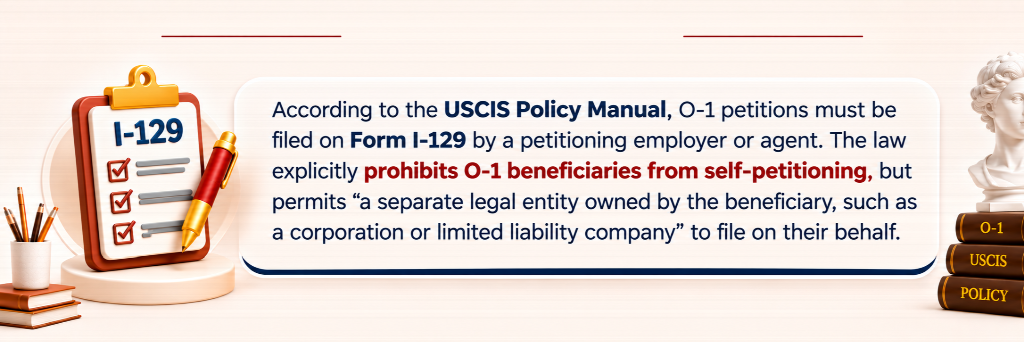
Therefore, the term “sponsorship” can be legally misleading. It primarily implies that a third party independent of you is providing you with the opportunity but the range of legally permissible petitioners is far broader than this.
II. Agent Route: Applicable Scenarios and Statutory Conditions
Agent Route: Applicable Scenarios and Statutory Conditions
- Purpose of the Agent Route
- Conceived for workers who are conventionally self-employed or who undertake short-term assignments across multiple employers.
- Conceived for workers who are conventionally self-employed or who undertake short-term assignments across multiple employers.
- Multiple Employer Situations
- Where a beneficiary works for multiple employers, each employer must file a separate petition, unless an established agent files on the beneficiary’s behalf.
- Where a beneficiary works for multiple employers, each employer must file a separate petition, unless an established agent files on the beneficiary’s behalf.
- Role of the Agent
- The agent assumes the status of petitioner of record.
- This proves particularly advantageous for:
- Founders who have not yet established a U.S. entity.
- Independent contractors who must aggregate multiple engagements.
- Founders who have not yet established a U.S. entity.
- The agent assumes the status of petitioner of record.
- Mandatory Itinerary Requirement
- Where the petition contemplates work at multiple locations, it must be accompanied by an itinerary specifying dates and locations.
- The itinerary must, at minimum, delineate:
- The nature of the work the beneficiary will perform.
- The location(s) of performance.
- The timeframe of performance.
- The nature of the work the beneficiary will perform.
- USCIS retains a measure of discretion regarding the requisite level of detail, accounting for industry practice; the itinerary itself, however, cannot be omitted.
- Where the petition contemplates work at multiple locations, it must be accompanied by an itinerary specifying dates and locations.
- Limitations of the Agent Route
- Where the beneficiary’s circumstances more closely resemble “working primarily for a single company they own,” the company petition route may prove more appropriate.
- Conversely, where the beneficiary genuinely operates as an independent professional serving multiple clients, the agent route affords greater flexibility.
- Where the beneficiary’s circumstances more closely resemble “working primarily for a single company they own,” the company petition route may prove more appropriate.
III. Founder Route: Entity Structure and Employer-Employee Relationship
For founders, having their own U.S. company file the petition is the most direct pathway. USCIS policy explicitly permits this . However, in practice, the key issue is whether a genuine employer-employee relationship exists.
Legal practitioners summarize the test as: “whether someone at the company could credibly fire you” . This means the company must have independent authority over your role, not exist solely as your instrument.
Specific structural considerations include:
C-Corporation with a board of directors is typically viewed as having clearer independence. Corporate governance documents, board authority, and employment agreements together can demonstrate that the company is a separate legal entity with decision-making power over the beneficiary .
Single-member LLC is not automatically disqualified, but requires more meticulous documentation to prove the company is a genuine operating business rather than the beneficiary’s personal financial conduit. Evidence of independent corporate formalities, operational records, and actual business activities becomes particularly important.
The inherent risk of this pathway is: the O-1 status is tied to that company. If the company ceases operations or the beneficiary stops working there, a new petitioner must be found to maintain status.
IV. Evidence Review: The Focus Is Always on the Beneficiary
Regardless of which petitioner structure is chosen, the core of the O-1A petition is the beneficiary’s own qualifications. O-1A requires demonstrating sustained national or international acclaim, meeting at least three of eight criteria. For founders, the most commonly used criteria include:
- Original contributions of major significance: USCIS focuses on whether the contribution is of “major significance” to the field. Publication or patenting alone does not automatically establish significance; evidence of commercialization, widespread citation, or significant attention attracted by the patent may be probative. If a patent remains pending, USCIS will likely require additional supporting evidence .
- Critical or essential capacity for organizations with a distinguished reputation: For founders, this may involve demonstrating that the startup has a distinguished reputation or has received merit-based government funding (such as SBIR). VC funding itself does not satisfy the “awards” criterion, but may be used as supporting evidence for the “critical role” criterion .
- High salary or remuneration: Must be relative to others in the same field. For startup founders, equity-based compensation may be presented as comparable evidence, but faces higher scrutiny at the evidentiary stage .
- Additionally, any O-1 petition must include: written contracts (or summaries of oral agreement terms), an explanation of the nature and dates of activities, an itinerary, and a written advisory opinion from a peer group .
V. Further Reading: How to Select an O-1A Attorney

The petitioner structure resolves the “who files” question, but whether the petition is approved depends on whether the evidence is properly organized and presented. The same set of credentials, if not framed within the correct legal criteria, may fail to persuade USCIS.
When selecting an O-1A attorney, founders should focus on the following practical points rather than a firm’s overall brand:
Ask specific questions. How many O-1 petitions for founders who own their own companies have you filed in the past two years? Which criteria do you typically build founder petitions around, and why? How do you handle the employer-employee relationship when the founder owns 100% of the company?
Examine the drafting process. Who actually drafts the petition letter and who signs it? Ideally, an attorney with founder-case experience both drafts and signs, rather than a paralegal drafting with only cursory attorney review .
Understand the RFE response plan. USCIS FY2026 Q1 data shows that 26% of completed O-1 extraordinary ability petitions received Requests for Evidence . Ask who will write the RFE response and whether that person is the same attorney who handled the initial filing.
Beware of low-price traps. A flat fee below $3,000 is difficult to sustain for a genuinely prepared O-1A petition. The minimum realistic time investment is thirty to fifty attorney hours, with experienced immigration attorney billing rates in major markets ranging from $300 to $600 per hour or higher .
Contact SiliconPath Law to schedule a consultation with an attorney experienced in founder-owned-company O-1A petitions; one who will ask the right questions, personally draft and sign your petition, handle any RFE with the same attorney who filed your case, and charge a fee commensurate with the thirty to fifty hours of work a properly prepared petition requires. We welcome the opportunity to discuss your case and help you make an informed decision about your representation.
Disclaimer: This article is for informational purposes only and does not constitute legal advice. Immigration law is fact-specific, and you should consult a qualified immigration attorney regarding your individual circumstances.
FAQs
1. Can I self-petition for an O-1 if I own my company?
No. Beneficiaries may not self-petition but a separate legal entity you own, such as a C-Corp or LLC may file on your behalf. The regulation here is that it must be a genuine employer authority over your role. An entity controlled solely by you, without external governance may be deemed an alter ego and risk denial.
2. What distinguishes “sponsorship” from “petitioning”?
O-1 law does not follow an independent concept of “employer sponsorship”. This means its major requirement is an eligible petitioner. While “sponsorship” colloquially denotes the petitioner role, permissible petitioners extend beyond traditional employers to include your own company or a U.S. agent.
3. When is the agent route appropriate?
The agent route suits founders without a U.S. entity. This primarily implies independent contractors with multiple engagements and beneficiaries working across multiple employers. Where the beneficiary works primarily for a single company they own, a company petition is generally more appropriate. Multi-location petitions require an itinerary.
4. What evidence is most significant for a founder’s O-1A?
Adjudication centers on the beneficiary’s qualifications; sustained acclaim satisfying at least three of eight criteria. Founders commonly rely on original contributions of major significance, critical capacity for distinguished organizations and high salary relative to peers. Petitions must also include contracts, an activity explanation, an itinerary and a peer advisory opinion.
5. How should counsel be selected?
Ask how many founder-owned-company O-1 petitions the attorney has filed in the past two years and how they address the employer-employee relationship where the founder holds complete ownership. Confirm who drafts and signs the petition and who handles any RFE response. Exercise caution regarding flat fees below $3,000. Note that proper preparation realistically requires thirty to fifty attorney hours.