

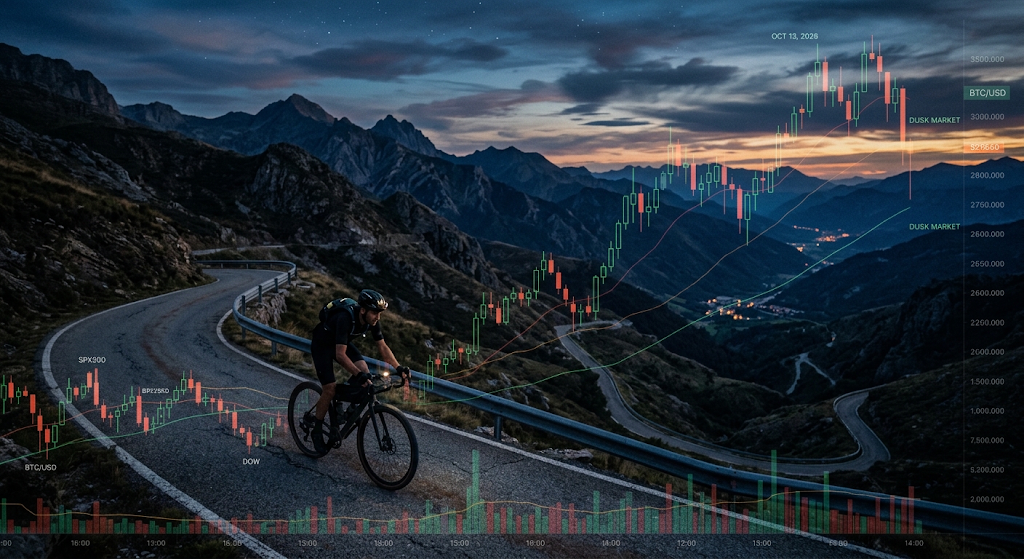
Risk is rarely a spreadsheet equation neatly wrapped in a corporate quarterly report. In the sterile corridors of traditional finance, probability is often treated as a tamed beast, caged by historical data and risk-management models that assume tomorrow will politely mirror yesterday. Yet, true volatility wears mud on its boots or hangs by a fraying carabiner 4,000 meters above sea level.
To understand how modern enterprises navigate systemic uncertainty, we must look away from the boardroom and toward the solitary cyclist hurtling down a descent at 90 kilometers per hour, the alpine climber evaluating a shifting serac wall, and the digital trader watching order books bleed red. These domains share a common denominator: survival depends not on eliminating risk, but on mastering its rhythm.
The Cyclist and the Margin of Deceleration
Consider the peloton of a grand tour. Every rider knows that speed is cheap; control is expensive. The amateur views a corner as a geometric problem to be solved at maximum velocity. The professional views it as a dynamic margin of error where kinetic energy must be traded for positional survival.
Corporate strategy often suffers from the amateur delusion – chasing rapid market share while ignoring the braking distance required when market conditions pivot instantly.
- Anticipatory line choice: Cyclists look three riders ahead, reading microscopic shifts in body weight to predict crashes before they ripple backward. Businesses must similarly track micro-signals in consumer behavior instead of waiting for macroeconomic collision reports.
- Drafting and energy conservation: Riding in the slipstream reduces wind resistance by up to 40 percent. Smart enterprises leverage ecosystem partnerships and shared platforms to preserve capital reserves rather than burning resources on solo headwinds.
- The psychological descent: Fear causes target fixation, where a rider stares directly into the barrier they wish to avoid and inevitably hits it. Markets reward leaders who keep their eyes on the exit vector rather than fixating on the obstacle.
Altitude, Hypoxia, and the Trader’s Terminal
In high-altitude mountaineering, decisions are made under severe cognitive hypoxia. Oxygen deprivation degrades executive function, turning complex analytical choices into binary survival impulses. Experienced climbers combat this through rigid checklists and pre-committed turnaround times, stripping emotion from the summit push.
Similarly, financial traders operate in an environment of perpetual sensory overload. Whether navigating traditional equities or exploring digital assets through advanced analytical portals like ca.parimatch.com/en/crypto-casino, the core discipline remains identical: adherence to system parameters over emotional impulses.
- Pre-computed exit thresholds: Just as a climber establishes a strict turnaround time regardless of how close the peak appears, successful traders automate their stop-losses to eliminate mid-crisis rationalization.
- Sunk cost ruthlessness: Abandoning an expedition 100 meters from the summit because weather windows close is agonizing, but it preserves life. In business, killing a failing project early is the ultimate competitive advantage.
- Calculated exposure: Risk is never absolute; it is dosed. Just as a mountaineer scales technical difficulty incrementally through acclimatization cycles, market participants scale their risk exposure in alignment with their emotional and financial capital buffers.
Rewriting the Corporate Playbook
When we synthesize these worlds, business ceases to be a static game of chess and becomes an endurance triathlon. The organizations that thrive in volatile decades are those that institutionalize athletic grit and trading pragmatism. They build cultures that respect the physics of momentum, honor the limits of human endurance under pressure, and treat uncertainty not as a threat to be banished, but as the very medium through which competitive advantage is forged.