

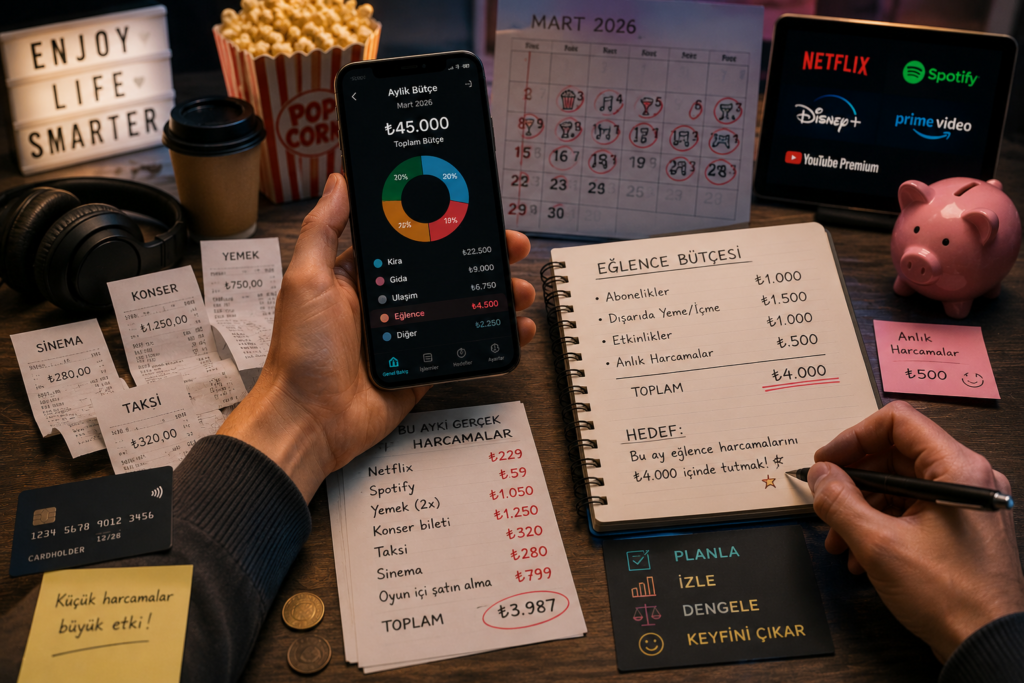
Entertainment is the category most people budget last and overspend first. It’s not because they’re irresponsible but because entertainment spending is emotional, impulsive, and spread across too many small transactions to track easily. A concert here, a streaming upgrade there, a night out that cost twice what you expected.
By the end of the month, the number is always higher than you thought.
Why Entertainment Budgets Fail Before They Start
The standard advice is to pick a percentage of your income and stick to it. Ten percent, fifteen percent or whatever feels right. The problem is that this approach treats entertainment as a single, manageable category. It isn’t.
Entertainment in 2026 is fragmented across platforms, subscriptions, live events, digital purchases, and spontaneous decisions. Each of those operates on a different psychological trigger. A subscription renews automatically and barely registers. A concert ticket feels like a special occasion. A spontaneous dinner out doesn’t feel like “entertainment” at all. It just feels like a Thursday.
Turkey’s cost of living shifts have made this harder. With inflation affecting leisure prices unevenly — concert tickets rising faster than streaming costs, for instance — a fixed percentage budget becomes unreliable almost immediately.
Digital entertainment platforms multiply the challenge. Lüx gazino is one platform in the broader digital leisure space where spending can accumulate quickly without obvious checkpoints. Understanding how these environments are designed helps you engage with them more deliberately, whatever your platform of choice.
Building a Budget That Reflects How You Actually Spend
The most effective entertainment budgets aren’t built around categories. They’re built around behaviour.
Start by tracking (not planning, just tracking) for one full month. Don’t change anything. Just record every entertainment-related spend as it happens. Most people are genuinely surprised by what they find. Not because they’ve been wildly reckless, but because the small, frequent purchases add up in ways that the occasional big purchase doesn’t.
After that month, you have real data to work with instead of guesses.
The Structure That Tends to Hold
A workable entertainment budget in 2026 usually has three layers:
- Fixed subscriptions — streaming services, apps, memberships. Audit these first. Most people are paying for at least one they barely use.
- Planned discretionary — concerts, travel, dining out for occasions. Budgeted monthly but spent irregularly, so a rolling account works better than a monthly ceiling.
- Impulse allowance — a small, guilt-free amount set aside for spontaneous decisions. Having this category explicitly prevents the psychological cost of “breaking the budget” on small, unplanned things.
The third layer is the one most budgets leave out, and its absence is often why people abandon the whole system after a few weeks.
According to the OECD’s financial literacy framework, sustainable personal budgets consistently share one feature: they account for realistic human behaviour rather than idealised behaviour. A budget with no room for impulse spending doesn’t reflect how people actually live and people stop using budgets that don’t reflect reality.
Adjusting as the Year Moves
A budget set in January doesn’t survive contact with the rest of the year unchanged. That’s fine because the goal isn’t rigidity, it’s awareness.
Entertainment spending has natural peaks. Summer in Turkey brings outdoor events, travel, and social spending that simply don’t exist in February. Ramadan affects routine spending patterns for a significant portion of the population. End-of-year holidays shift the whole picture again.
What Good Adjustments Look Like
Rather than abandoning the budget when a peak month hits, build a review rhythm into the process:
- Check totals every two weeks, not every month. Monthly reviews are too infrequent to catch drift early.
- Adjust category allocations seasonally, not just when you’ve already overspent.
- When a one-off big expense arrives, decide in advance whether you’re pulling from savings or redistributing from another category.
The reviews don’t need to take long. Fifteen minutes every other Sunday is enough to stay on top of it. What matters is consistency, not precision.
Entertainment spending isn’t the enemy of financial health. Unexamined entertainment spending is. The difference between those two things is usually just a system simple enough to actually use.